TDMA
full mesh Satellite Communication System-LinkWay
LINKWAY
is a multi-carrier, multi-rate, time-division
multiple access (TDMA), VSAT-like (very small
aperture terminal) platform that works with
conventional satellites. It provides seamless
full-mesh connectivity for flexible, on-demand
broadband corporate networking applications. The
LINKWAY system can support thousands of low-cost
terminals with small antennas. Single-hop
connectivity is a standard feature without the
need for an expensive central hub station.
Current LINKWAY network products include:
·LINKWAY 2000â—This
terminal fully supports ATM, Frame
Relay, IP, and ISDN standards directly on the indoor unit and is
more suited for gateway applications and existing earth stations
with 70 MHz IF interface. This terminal can be stacked for higher
throughput applications.An optional circuit switching voice
adapter card (LVA) providing 8 Mbps encoded voice and echo
cancellation is also available.
·LINKWAYä
2100—This
terminal fully supports ATM, Frame
Relay, IP, and ISDN and uses an integrated radio frequency
terminal. LINKWAY 2100 is more cost effective for remote
VSAT applications. This terminal uses an L-band RFT interface
in support of broadband applications that span multiple satellite
transponders. Unique auto-commissioning features allow quicker
and more economical deployment for large remote populations.
·linkway.IPä—This
terminal fully supports IP. Packaged with
smaller RFTs (2W, 4W, 5W) for star or multi-star topologies, it is
targeted for ISPs and corporate intranet applications. Unique IP
software allows higher throughput IP applications.
Using this family of LINKWAY products, the system
automatically allocates satellite bandwidth on a
call-by-call basis, based on dynamically measured
traffic levels or on a fixed-assignment basis, if
necessary.
In
addition to efficient TDMA and automated bandwidth
on demand (BoD), LINKWAY eliminates the need for
additional third-party networking equipment. This
results in improved overall network reliability,
lowered costs, and simplified integration with
terrestrial networks.
The
LINKWAY platform incorporates enhanced features
providing a unique architecture that supports
mesh, star, virtual star, and hybrid topologies.
The product’s inherent flexibility allows
individual VSAT locations to be configured as very
low-cost remote terminals and economical
high-capacity gateways. LINKWAY broadband VSATs
support multiple antenna and RF transceiver configurations
with flexible carrier parameters that include
variable bit-rates, power levels, and forward
error correction (FEC) settings for each carrier.
Every
LINKWAY network has three basic parts:
* The LINKWAY indoor unit (IDU)
* The LINKWAY
outdoor unit (ODU)
* The heart of the LINKWAY network is the Network Control
Center (NCC)—a
Sun
workstation—which provides the
management and
control functions for all network terminals.
Figure1 illustrates a small network, with its NCC and NMS co-located with one
of the LINKWAY IDU/ODU combinations, called a
LINKWAY site.
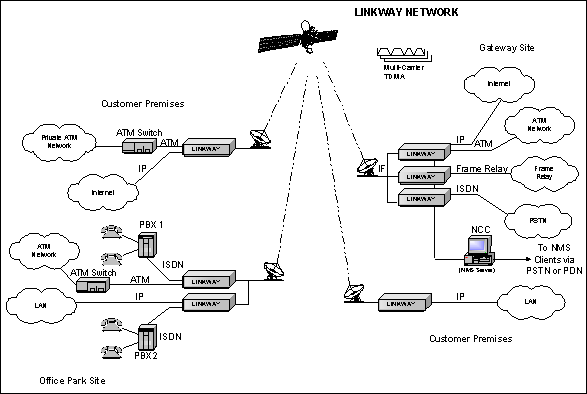 Figure
1:
A LINKWAY Network
Figure
1:
A LINKWAY Network
Broadband VSATs like LINKWAY are ideal for
the current and emerging wideband multimedia
applications encountered by multinational
corporations, carriers, service providers,
virtual private network operators, and
Internet service providers (ISPs). An effective
broadband VSAT platform must provide the following
capabilities in order to address today’s
diverse multimedia networking applications, which
are discussed below:
·SUPPORT
FOR A BROAD RANGE OF NETWORK
TOPOLOGIES
The three most popular and regularly encountered topologies include star (hub-and-spoke networks), mesh
(any-to-any connectivity in one satellite
hop), and virtual star or multi-star (hybrid networks with multiple hub
locations). These are illustrated in Figure
2:
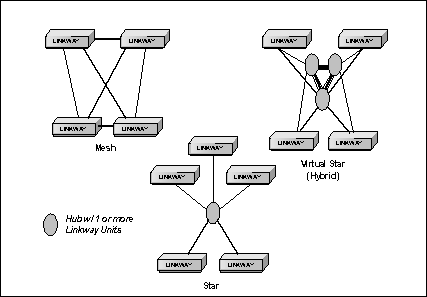 Figure-
2
LINKWAY—Three Topologies, One Platform
Figure-
2
LINKWAY—Three Topologies, One Platform
A typical star network consists of a
central hub location with many remotes supporting
asymmetric outbound and inbound traffic
requirements. Applications include application–specific
interactive systems in banking, retail, and
other industrial sectors; PSTN network extensions;
broadcast services; and Internet network
extensions.
A
mesh
network consists of many terminals with
one or two assigned to administer the network, no
central hub location (although optional higher
traffic gateways are possible), and support for
any-to-any connectivity on one satellite hop.
Applications include telemedicine, corporate
wide-area voice and data communications, LAN
extensions and videoconferencing.
A virtual
star or hybrid network consists of two or
more hubs or gateways and provides mesh
connectivity between hubs, remote-to-multiple
hub connectivity, and asymmetric data rates.
Virtual star networks are essentially two-tiered
topologies supporting high-traffic gateways
with mesh connectivity to each other and small
remote locations that are connected to the
high-traffic gateways. Each tier requires links
that provide fiber-like bit error ratio (BER)
performance and asymmetric transmission rates.
Typical applications include multinational corporate
intranets, and service provider-operated
virtual private networks.
LINKWAY
supports all three topologies, as well as:
* Standard interfaces for packet-switched
(IP, ATM, Frame Relay)
and circuit-switched
(ISDN) networking applications.
* Broadband data rates between 312 ksps and 5 Msps.
* Demand assigned allocation of bandwidth.
LINKWAY
is a powerful platform supporting high-rate,
multiple protocol services for high-end
applications, and affordable (small-aperture)
remote terminals operating over low-rate carriers
as well. The system operates seamlessly because
larger VSAT sites can carrier-hop between large
and small carriers as required by changing
connectivity requirements.
In
a single-beam configuration, as illustrated in Figure3, the NCC links all
of the traffic terminals in the network through
the master reference terminal (MRT). (In Figuret 3, dotted lines indicate redundancy.)
In all cases, each LINKWAY terminal is
capable of serving both as a reference and a
traffic terminal. (The MRT, however, must reside
at the same site as the NCC.)
For
instance, the MRT in Figure3
controls all geographic locations in the network.
The NCC is co-located with the MRT, and both can
be backed up by using an alternate master
reference terminal (AMRT) and another NCC in a
redundant configuration.
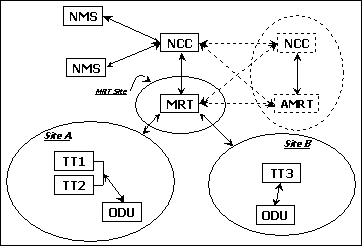
Figure
3
:
Single-Beam Configuration
If
the configuration is multiple-beam, as in Figure
4, there is also a supporting reference
terminal (SRT) to control the traffic terminals
associated with each satellite beam the MRT cannot
see. The SRT relays NCC commands from the MRT.
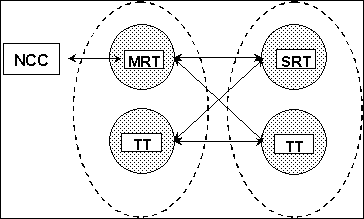
Figure
4
:
Multiple-Beam Configuration
·SUPPORT FOR PACKET- AND CIRCUIT-SWITCHING
PROTOCOLS
Broadband
VSATs need to provide native support for the most
important and widely used packet-switching and
circuit-switching protocols. This allows seamless
transitions between the terrestrial and the
satellite networks and
reduces or eliminates the need for
additional third-party networking equipment. The
LINKWAY indoor unit supports IP, ATM, and Frame
Relay packet-switching protocols, and ISDN
circuit-switching protocols.Legacy protocols, such
as X.25 and SDLC, are supported over LINKWAY via a
connected router using a standard LINKWAY
interface.
* IP Service
Features
* ATM Service
Features
* Frame
Relay Service Features
* ISDN Service
Features
* Legacy Protocol Support
·FLEXIBLE
CONNECTIVITY AND SATELLITE ACCESS
Broadband
multimedia applications require flexible network
architectures and a variety of satellite
connectivity options. LINKWAY provides a
multi-carrier (up to 256 carriers),
multi-data-rate TDMA platform that can operate on
one or more satellite transponders and supports
flexible connectivity for any networking
requirement.
The
TDMA burst modem within the VSAT platform operates
at symbol rates between 312 ksps and 5 Msps to
address a diverse range of broadband multimedia
content. The transmit-and-receive data rates can
be set independently for asymmetric transmission
applications such as those typically encountered
with IP applications. In addition, robust
satellite links are possible with fiber-like BER
performance since each carrier is assigned a
convolutional-Viterbi inner code and a
Reed-Solomon outer code.
LINKWAY
is operable on any international or regional
geosynchronous satellite system. Common frequency
bands include C- and Ku-band; the system will also
operate on bent-pipe
Ka-band satellite systems.
·EFFICIENT
DEMAND-ASSIGNED BANDWIDTH
MANAGEMENT
The
LINKWAY system runs a central bandwidth management
program in order to efficiently use space segment
and provide high levels of end-user data
throughput.
The bandwidth management function performs both fixed
bandwidth allocation and dynamic bandwidth
allocation (bandwidth on demand):
* Fixed bandwidth allocation—Certain
traffic categories in ATM
and Frame Relay, and the circuit-switched nature of ISDN calls,
require bandwidth to be allocated for the entire duration of
the call. In these cases, bandwidth is allocated at call (or
connection) setup and remains allocated for the entire duration of
the call. The bandwidth is de-allocated when the call
ends (or the
connection is torn down).
* Dynamic bandwidth allocation (bandwidth
on demand)—
Every LINKWAY terminal runs a Bandwidth Reporter program
that continuously monitors the incoming user traffic.
The dynamic bandwidth allocation function collects the
reports from all traffic terminals and periodically runs
an algorithm to distribute available bandwidth resources
fairly and efficiently using three levels of fairness:
* Outgoing Fairness—All connections originating from a
particular terminal compete for the terminal’s
total transmit
capacity in a fair manner.
* Incoming Fairness—All
connections terminating at a particular
terminal
compete for the terminal’s total receive capacity in a fair
manner.
* System Fairness—All connections in the entire network
compete
for the total system capacity in a fair manner.
This
algorithm provides bandwidth allocation in
response to changing incoming user traffic rates
in a dynamic manner.
·DIVERSE
NETWORK APPLICATIONS
LINKWAY
is particularly well-suited to the diverse
topologies needed for today’s wideband networks.
Service providers and multinational corporations
can economically establish mesh, star, or virtual
star networks using a single platform.
Popular broadband VSAT network examples include:
* Virtual private networks;
* Private corporate networks;
* Internet service providers;
* Real-time digital video internetworking;
* Wireless interconnectivity; and
* Disaster recovery.
·LINKWAY'S
SUBSTANTIAL BENEFITS
Networks
based on LINKWAY products have clear advantages
over the existing VSAT systems in the market. The
benefits of LINKWAY networks include:
* LINKWAY networks use a hub-less
architecture;
* Multi-protocol support enables easy
migration to emerging
applications;
* LINKWAY networks support asymmetric
traffic requirements;
* LINKWAY networks support both full-mesh
and star topologies
on a single platform in a
single hop;
*
LINKWAY’s unique patented dynamic
bandwidth-on-demand
(BoD) algorithm distributes
network bandwidth among many sites
effectively and efficiently as needed;
* In situations where the wideband content
is provided from various
destinations, LINKWAY
networks support multiple gateway
network
architectures without a hub; and
* LINKWAY networks support multimedia
applications through
standard native ATM, Frame
Relay, IP, and ISDN interfaces.
This enables LINKWAY terminals to interface
seamlessly with
existing terrestrial networks and
to improve overall network
reliability by
minimizing the need for additional third-party
devices.
|