DVB-RCS Topology Star Satellite Communication System-LinkStar
Introduction
LinkStar is a new two-way broadband satellite
communications
system for Internet Protocol connectivity over
satellite. LinkStar
consists of one or more central stations – the hub
–, many remote
VSATs (Very Small Aperture satellite communication
Terminals),
and appropriate management and control subsystems.
The remote VSAT – called the Return Channel Satellite
Terminal (RCST) – is
a small, low cost terminal designed for multimedia
broadband
connectivity in networks with a large number of
sites.
Because of the low cost of the remote terminal,LinkStar is an ideal
solution for large enterprises and service providers
(e.g., VPNs and
ISPs) that need broadband IP connectivity for
multimedia
applications over a large geographic area. A single
hub can
connect up to 10,000 remote terminals, and a
multi-hub LinkStar
system can integrate as many as 100,000 remotes into
a single
network.
This document presents a high level description of the LinkStar product.
Product Overview
LinkStar is designed to offer high-throughput
connectivity between
a large number of remote users and one or
more hubs, configured
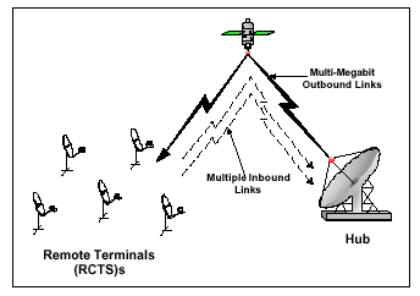
in a “star” network topology. The connectivity
is asymmetric, with
a large capacity outbound satellite link from
the hub to the remote
terminals, and many medium capacity inbound satellite
links from
the remotes to the hub. This is depicted in Figure 1
below.
The LinkStar system consists of the following:
1. One or more hubs,
2. Return Channel Satellite Terminals (RCST),
3. Network Management System (NMS),
4. Network Control Center (NCC) and Regional NCCs
(RNCC),
and
5. Space Segment over a bent pipe satellite.
The Hub
The central station consists of a large antenna
(typically 6 meters in diameter), transmit and receive RF equipment, as well as transmit and receive Hub Common Equipment (HCE).
The transmit HCE consists of a router to interface
to the external
IP network, a DVB-IP encapsulator to embed the IP
data into an
MPEG-2 format, a DVB multiplexer, a continuous
modulator,
and a timing clock
.
The receive HCE consists of a timing and
distribution MF-TDMA
demodulator unit and multiple MF-TDMA demodulator
units
for each inbound carrier to be received
simultaneously.
Each
demodulator receives an inbound link from a large
number
of
remote RCSTs. The number of optional demodulators depends on the number of
inbound links.Figure 2 depicts the block diagram of the LinkStar
hub.
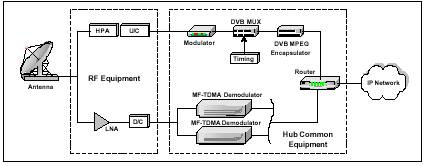
Figure 2 – LinkStar Hub Block Diagram
The RCST
The remote RCST (Return Channel Satellite Terminal)
is a small VSAT consisting of an IDU (indoor unit) and an ODU
(outdoor
unit). The ODU consists of an antenna (96cm, 1.2m,
1.8m or
2.4m) and an RF power amplifier and low noise
receiver.
The IDU is an integrated unit. The MPEG-2 stream is
recovered
from the outbound signal by an integrated circuit
consisting of a
DVB demodulator and demultiplexer. This logic
demodulates
the outbound signal and the demux recovers the IP
packets and
time-stamps encapsulated in the MPEG-2 stream, which
are then
delivered to the external network via a 10/100
Base-T interface.
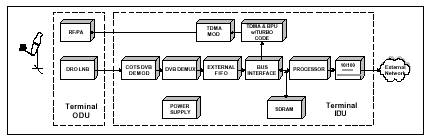 Figure 3 – LinkStar RCST Block Diagram
Management and Control
LinkStar management and control functions are
performed by the NMS (Network Management System), the NCC (Network
Control
System) and RNCCs (one Regional NCC per outbound
carrier).
The LinkStar network NMS, because of its web-based
design, is
very user-friendly and flexible. It performs the
traditional NMS
functions of Configuration, Control, Performance,
and Alarm
Management, as well as Accounting, and User
Administration.
It also provides an interface to download software to
the RCSTs from
the hub.The NMS architecture is illustrated in Figure 4.
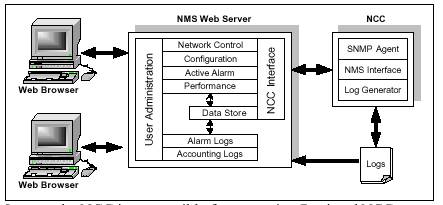 Figure 4 – LinkStar NMS Architecture
In turn, the NCC is responsible for managing
Regional NCCs
(RNCCs), managing the overall allocation of blocks
of bandwidth
to individual regions, providing an interface to the
NMS, SNMP
code for configuration and management of the
network, and
providing an interface for the storage and retrieval
of configuration
information.
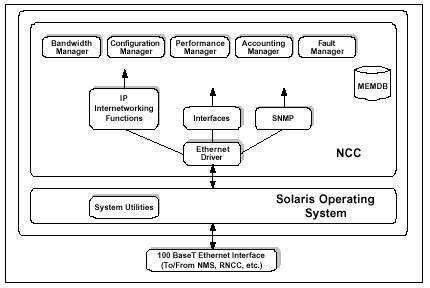
Figure 5 – LinkStar NCC Architecture
A LinkStar network may have one or more RNCCs, one
for each
outbound carrier. The RNCC is responsible for the
management
of all RCSTs associated with its region and outbound
carrier.
RNCC functions include, for example, the allocation
of bandwidth within the region, acquisition and
dissemination of
configuration information, and management of RCST
acquisition
and synchronization.
Space Segment
The space segment for a LinkStar network is of the
bent-pipe type, such as Ku-band and C-band transponders of any
global or regional satellite system. The satellite capacity
may be loopback (such as global or regional coverage) or non-loopback
(such as East-West.)
The LinkStar space segment is made up of one or more
broadband outbound links, and many inbound links.
Outbound Link
The outbound link – from the hub to the remotes
– is a multi-megabit data stream that is compliant with the DVB-MPE
format.
Information is sent from the hub terminal to the
large number
of remotes over this common link, with the
following operating parameters:
· Transmission
Rate: Selectable rate (5 to 42.5 Msps)
· Format:
Continuous (TDM)
·
Modulation/FEC: ETSI-compliant (EN-301210)
modulation and FEC
(forward error correction)
formats:
(a) QPSK with concatenated coding (inner
convolutional FEC and
outer RS), or
(b)
8-PSK with concatenated coding (inner Pragmatic Trellis
Coded Modulation (PTCM), outer RS)
·
Transport Stream: MPEG-2 and DVB Multi-Protocol
Encapsulation
(DVB-MPE) format for IP data.
Inbound Link
In the inbound direction – from the remotes to the
hub – the LinkStar network uses multiple links that are shared
by associated groups of remote terminals. The inbound
link is compliant with a subset of the DVB-RCS standard,
with the following operating parameters:
· Transmission
Rate: Selectable rate (156.2, 312.5, 625 or 1250
Ksym/sec)
·
Format: Demand assigned bursts over multiple TDMA
(Time
Division Multiple Access) carriers
· Modulation/FEC:
Burst QPSK with Rate 2/3 Turbo Code FEC.
· TCP
Acceleration: TCP “spoofing” support.
Key Features
Other LinkStar important features are indicated
below.
· Network
limitation – 5,000+ RCSTs supported per outbound
carrier, expandable to
100,000
terminals in total.
· Two-way
satellite transmission – 5 to 42.5 Msps outbound
carrier,
and multiple
0.156 to 1.25
Msps inbound carriers, with bandwidth
automatically allocated based on demand.
·
Many Internet Protocol enhancements:
(a) Multicast within user groups
(b) Full routing protocols at remote (RIP1 and RIP2)
and at hub
(BGP4)
(c) Diffserv-based QoS
(d) TCP acceleration (spoofing).
·
Comprehensive NMS/NCC functionality:
(a)
Support for all NMS ISO elements –
configuration, control,
performance, alarm, and administration (authentication,
accounting,etc.)
(b) User-friendly Web-based GUI interfaces
(c) SNMP support
·
Support for C-band, Ku-band, and Ka-band RFT
LinkStar Applications
·
Internet Service Providers
·
Private Corporate Networks
·
Virtual Private Networks
·
Telemedicine
·
Voice over IP
·
Distance Education
Summary
Cost-effective and flexible large-scale two-way
broadband multimedia networks are now possible with LinkStar
S
, the powerful new VSAT platform from Lockheed Martin.
This new satellite communications platform combines the
inherent flexibility and immediate infrastructure made
possible by existing satellite systems operating at C, Ku and Ka
frequency bands, with native support for Internet Protocol,
flexible network connectivity options, and bandwidth-on-demand.
With the convergence of applications over IP, many
new applications and business opportunities arise every
day in geographic regions with insufficient or nonexistent
copper and fiber infrastructure. LinkStar now becomes the
solution of choice for this type of growing requirement.
|