SkyX
Technology

* Introducing the SkyX Gateway
Satellites are ideal for providing Internet and private network access over long
distances and to remote locations.However, the Internet protocols are not optimized for
conditions, and consequently, the throughput over satellite networks is satellite restricted
to only a fraction of the available bandwidth. Mentat, the leading supplier of TCP/IP to
the computer industry, has overcome these limitations with the development of the SkyX
product family.
The SkyX system replaces TCP over the satellite link with a protocol optimized for
the long latency, high loss,asymmetric bandwidth conditions typical of satellite communications.
Adding the SkyX system to a satellite network allows users to take full advantage of the
available bandwidth, increasing Web performance by 3 times or more and file transfer speeds
up to 10 to 100 times. The SkyX solution is entirely transparent to end users, works with all
TCP applications, and does not require any modifications to end clients and servers.
The SkyX family consists of the SkyX Gateway, Sky Client/Server, and SkyX OEM
products. The SkyX Gateway is a hardware solution designed for easy installation into any
satellite network and provides performance enhancement for all devices on the network.
The SkyX Client/Server provides performance enhancement to individual PCs
For satellite
equipment manufacturers, Mentat licenses the SkyX OEM technology for
integration with
satellite modems, VSATs and other satellite networking equipment.
*
Performance of TCP Over Satellite
Satellites are an attractive option for carrying Internet and other IP traffic to the many
locations across the globe where terrestrial options are limited or price prohibitive. However,
data networking over satellites is faced with overcoming the large latency and high bit error rates
typical of satellite communications, as well as the asymmetric bandwidth design of most satellite
networks.
Communications over geosynchronous satellites, orbiting at an altitude of 22,300 miles,
have round trip times of approximately 540 ms, an order of magnitude larger than terrestrial
networks. The journey through the atmosphere can also introduce bit errors into the data stream.
These factors, combined with back channel bandwidth typically much smaller than that available
on the forward channel, reduce the effectiveness of TCP which is optimized for short hops over
low-loss cable or fiber. Satellite conditions adversely interact with a number of elements of the
TCP architecture, including its window sizing,congestion avoidance algorithms, and data ackn-
-owledgment mechanisms,which combine to severely constrict the data throughput rate that can
be achieved
over satellite links.
Window Size: TCP utilizes a sliding window mechanism to limit the
amount of data in
flight. When the window becomes full, the sender stops transmitting until it receives new ackno-
-wledgments. Over satellite networks, where acknowledgments are slow to return, the TCP
window size generally sets a hard limit on the maximum throughput rate. The minimum window
size needed to fully utilize an error-free link,known as the "bandwidth-delay product," is 100 KB
KB for a T1 satellite link and 675 KB for a 10 Mbps link. However, many implementations of TCP
are limited to a maximum window size of 64 KB and most operating systems use a default
window size of only 8 KB, imposing a maximum throughput rate over a satellite link of only 128
Kbps per connection, regardless of the bandwidth available.
Congestion Avoidance: In order to avoid the possibility of congestive network meltdown,
TCP assumes that all data loss is caused by congestion and responds by reducing the transmission
rate. However, over satellite links, TCP misinterprets the long round trip time and bit errors as
congestion and responds inappropriately. Similarly, the TCP "Slow Start" algorithm, which over
the terrestrial infrastructure prevents new connections from flooding an already congested
network, forces an excessively long ramp-up for each new connection over satellite. While these
congestion avoidance mechanisms are vital in routed environments, they are illsuited
to single-path
satellite links.
Data Acknowledgements: The simple, heuristic data acknowledgment scheme used by
TCP does not adapt well to long latency or
highly asymmetric bandwidth conditions. To provide
reliable data transmission, the TCP receiver constantly sends acknowledgments for the data
received back to the sender. The sender does not assume any data is lost or corrupted until a
multiple of the round trip time has passed without receiving an acknowledgment. This algorithm
does not respond well over satellite networks where the round trip time is long and error rates
are high. Further, this constant stream of acknowledgments wastes precious back channel band-
-width and if the back channel is small, the return of the acknowledgments to the sender can
become the system bottleneck.
* SkyX Technology Overcomes TCP Performance Limitations
SkyX products increase the performance of IP over satellite by transparently replacing
TCP for the hop over the satellite link with a protocol optimized for satellite conditions.
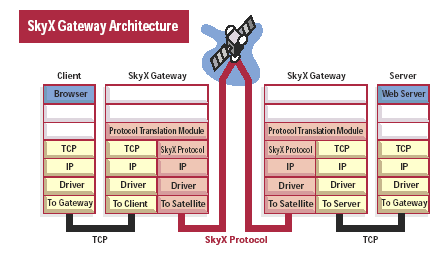
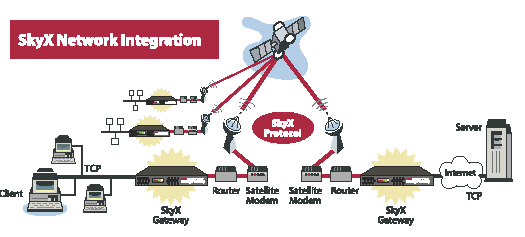
The SkyX Gateway works by intercepting the TCP connection from the client and conv-
-erting the data to the SkyX Protocol for transmission over the satellite. The SkyX Gateway on
the opposite side of the satellite link translates the data back to TCP for communication with the server. This architecture offers vastly
improved performance while remaining entirely transparent
to the end user and fully comp atible with the Internet
infrastructure. No changes are required to
the client or server, and all applications continue to function without modification.
This architecture is also referred to as TCP Performance Enhancing Proxy (TCP-PEP)
and is compatible with IETF RFC 3135.
The SkyX Gateway splits the single TCP connection into three separate components: A
TCP connection on the remote side between the client and SkyX Gateway, a SkyX Protocol
connection over the satellite between the two SkyX Gateways,and a TCP connection between the opposite SkyX Gateway and the server.
By splitting the end-to-end TCP connection, the segment over the satellite can use a
protocol optimized for satellite conditions while the terrestrial segments of the connection
continue to use standard TCP. TCP congestion avoidance mechanisms remain in place over
the terrestrial connections to protect the stability of the routed network. The two SkyX
Gateways pass control data between each other, allowing the SkyX Gateway on the opposite
side of the satellite to appear to be the original source or destination device. This architecture
maintains full TCP reliability and end-to-end flow control.
Because the SkyX Gateway is transparent to the end nodes, it can enhance the performance
of all TCP-based applications including Web access, file transfers, e-mail, Windows networking,
database connectivity, remote access, groupware, ERP, CRM,and other client-server applications.
The SkyX Gateway provides performance enhancement for all types of satellite networks,
including point-to-point, point-tomultipoint,and full mesh architectures. The SkyX Gateway can
also be used in multi-link configurations where a single SkyX Gateway hub unit enhances the
performance of multiple separate outbound links from a single uplink facility.
The SkyX Client/Server
product operates in a similar manner,
except the SkyX Client
software is installed on each end user's PC. Connections from applications running on the PC are
intercepted and sent over the satellite using the SkyX Protocol. At the network hub, a SkyX Server
establishes a TCP connection with the destination server.
* SkyX Performance
The performance benefits of the SkyX Gateway depend on many factors including the
bandwidth, delay, asymmetry and bit
error rate of the link, the number of simultaneous
connections, the compressibility of the data and the behavior of the application itself.Below are
data for two typical applications across a range of conditions.
File Transfers
The following FTP file transfer tests illustrate SkyX performance
enhancement for different
windows sizes, link bandwidths, round trip times, and bit error rates. Users should expect similar
results for any large single-connection data transfer. Each graph shows SkyX enhancement for
three cases: no compression, highly compressible text, and Corpus benchmark compressibility.
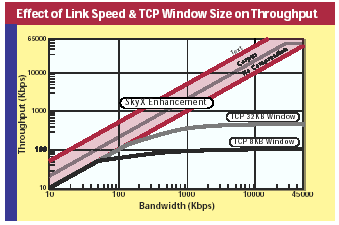
Window Size and Link Speed vs. Throughput:
Without performance enhancement, the default 8 KB TCP window found on most operating
systems limits throughput to less than 100 Kbps over satellite. As the graph on the left illustrates,
even on server operating systems which use a 32 KB window, TCP is only able to reach a thro-
-ughput of440 Kbps. The use of the SkyX Gateway overcomes this limitation to allow users to
take full advantage of the available bandwidth regardless of the window size of the client or
server. Depending on the compressibility of the data, users can even achieve throughput rates
far in excess of the bandwidth.
Round Trip Delay vs. Throughput:
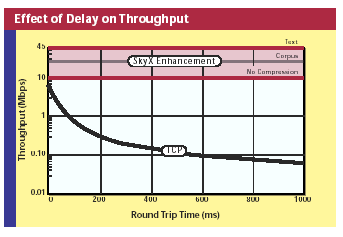
The SkyX Gateway removes the dependency of TCP on the round trip time of the link. The
figure to the right shows the measured throughput on an error-free, 10 Mbps link. These results
illustrate that TCP throughput drops rapidly as the round trip time increases. In contrast, the SkyX
Gateway is able to maintain full usage of the link regardless of the round trip time. For compres-
-sible text, the SkyX Gateway consistently delivers throughput rates more than four times the
actual bandwidth.
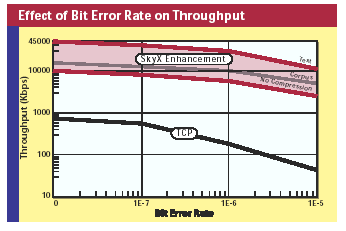
Bit Error Rate vs. Throughput:
Use of the SkyX Gateway overcomes the high sensitivity of TCP to the bit
error rate of the
link. The graph on the left shows the throughput as a function of the bit error rate for a 10 Mbps
satellite link using a 1 MB TCP window. Even at low error rates, TCP is able to deliver only 1.5
Mbps, while at an error rate of 1x10⁻⁵, TCP's throughput drops to less than 0.03Mbps.connection
using the SkyX Gateway fully saturate the link at low error rates and even at an error rate of ,
1x10⁻⁵, achieve 2.7 Mbps without compression and up to 10.9 Mbps for compressible data.
Web Performance
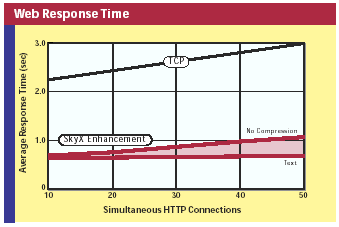
Unlike file transfers which typically consist of a single, large download,
Web traffic is charac-
-terized by large numbers of small connections.Mentat's unique FastStart feature specifically
ptimizes Web performance by reducing the time required to establish each new connection. The
Webstone HTTP benchmark shows that for an 8 Mbps error-free link, the average response time
for a mixture of 50 simultaneous Web connections using the SkyX Gateway is between 0.7 and
1.1 seconds depending on the compressibility of the data, compared to 3.0 seconds with TCP.
Other Applications
Performance benefits from applications other than Web and file transfers depend on the
characteristics of the application, but will typically fall between these two extremes.
*
SkyX Protocol Design
At the heart of the SkyX system is the SkyX Protocol, optimized to provide maximum
throughput for satellite networks. The SkyX Protocol is designed to respond efficiently to typical
satellite latency, bit errors, and asymmetric bandwidth conditions, and to take advantage of
optimizations possible on a single-path link with known bandwidth.
EFFICIENT ACKNOWLEDGMENT ALGORITHM:
The SkyX Protocol utilizes a highly-
efficient selective retransmission algorithm for the acknowledgment of data. Because there is only
a single path over the satellite for all packets with no intermediate routing, any gaps in the packet
sequence can be assumed to be data loss due to corruption rather than network congestion. The
receiving SkyX Gateway can immediately request and receive retransmission of the missing data
from the transmitting SkyX Gateway.
Because the SkyX Protocol does not use acknowledgments as the primary means of identify-
ing lost data, it requires only infrequent acknowledgments to confirm data arrival and clear buffers.
In contrast, TCP sends a constant stream of acknowledgments over the reverse channel. The
SkyX Protocol reduces back channel usage by 75% for Web traffic and up to 99% for file
transfers, thereby dramatically increasing the performance of networks where limited back
channel bandwidth is the system bottleneck.
DYNAMIC WINDOW SIZING: The large SkyX Protocol window effectively removes the
dependency of the network on the bandwidthdelay
product, allowing high throughput independent
of the window size of the end nodes. The SkyX Protocol dynamically adjusts
the window size
based on the link bandwidth, delay, and number of simultaneous connections to optimize utilization
of the
bandwidth.
QUALITY OF SERVICE (QoS): TCP uses Slow Start and Congestion Avoidance algorit-
hms to attempt to determine a safe transmission rate based on how quickly acknowledgments
return. This wastes available bandwidth when it transmits at too low a
rate and causes unnece-
ssary retransmissions when it transmits at a rate higher than the bandwidth of the link. Instead,
the SkyX Protocol uses rate control to explicitly set the transmission rate to exactly the bandwidth
of the link, thereby providing the maximum throughput possible.
FASTSTART WEB
ACCELERATION: In addition to TCP performance enhancement, SkyX
products include HTTP specific
optimizations to further accelerate Web downloads. FastStart
saves one full round trip time for each new Web connection by
reducing the handshaking required
to establish each new HTTP connection.
DATA COMPRESSION: Integrated on-the-fly data compression functionality, offering
lossless compression ratios of up to 5:1,
increases the amount of data that can be sent over
the link.
SKYX MULTICAST FAN-OUT: The unique SkyX Multicast Fan-out functionality can
transparently convert a TCP unicast connection
into a reliable multicast transfer. Using standard
file transfer applications such as FTP, the SkyX Gateway can deliver a copy of a
file to every
remote site with only a single transfer.
END-TO-END RELIABILITY AND FLOW
CONTROL: The SkyX system preserves the
end-to-end reliability of TCP so that all data
reaches the receiver despite any losses or bit errors
in any segment of the connection. The SkyX system also preserves
TCP's flow control
mechanisms to ensure fair utilization of the bandwidth by all users.
IP NETWORK COMPATIBLE: The SkyX Protocol runs over IP, making SkyX products
fully compatible with all standard networks and
IP networking equipment.
* SkyX Product Family
The SkyX family consists of the following products:
SKYX GATEWAY: The SkyX Gateway is a stand-alone hardware solution for use on any
satellite network. The SkyX Gateway provides performance enhancement for all devices on the
network and is ideal for backbone satellite links, corporate networks, VSAT networks, and other
satellite links to local area networks. The SkyX Gateway is available in two models, the XR10 and
XH45.The XR10 is designed for link speeds of up to 10 Mbps, or for use as a remote unit on hub-
spoke networks. The XH45 is designed
for link speeds of up to 45 Mbps and can be used as a
hub unit in combination with the XR10 at remote sites.
SKYX CLIENTSERVER
: The SkyX Client / Server solution provides performance enhanc-
ement
to individual PCs connected to a satellite network through a satellite receiver card or set-top
box.The SkyX Client software runs on Windows-based operating systems. The SkyX Server
hardware is available in two models, the SS10 and SS45. The SS10 is designed for link speeds of
up to 10 Mbps while the SS45 can handle link speeds of up to 45 Mbps.
SKYX OEM: Mentat licenses the SkyX Gateway technology in software source code form
for
OEM integration into satellite modems, VSATs, routers, caches, or any other satellite network-
ing
equipment. The SkyX OEM software is available for various computer and real time operating
systems.
|